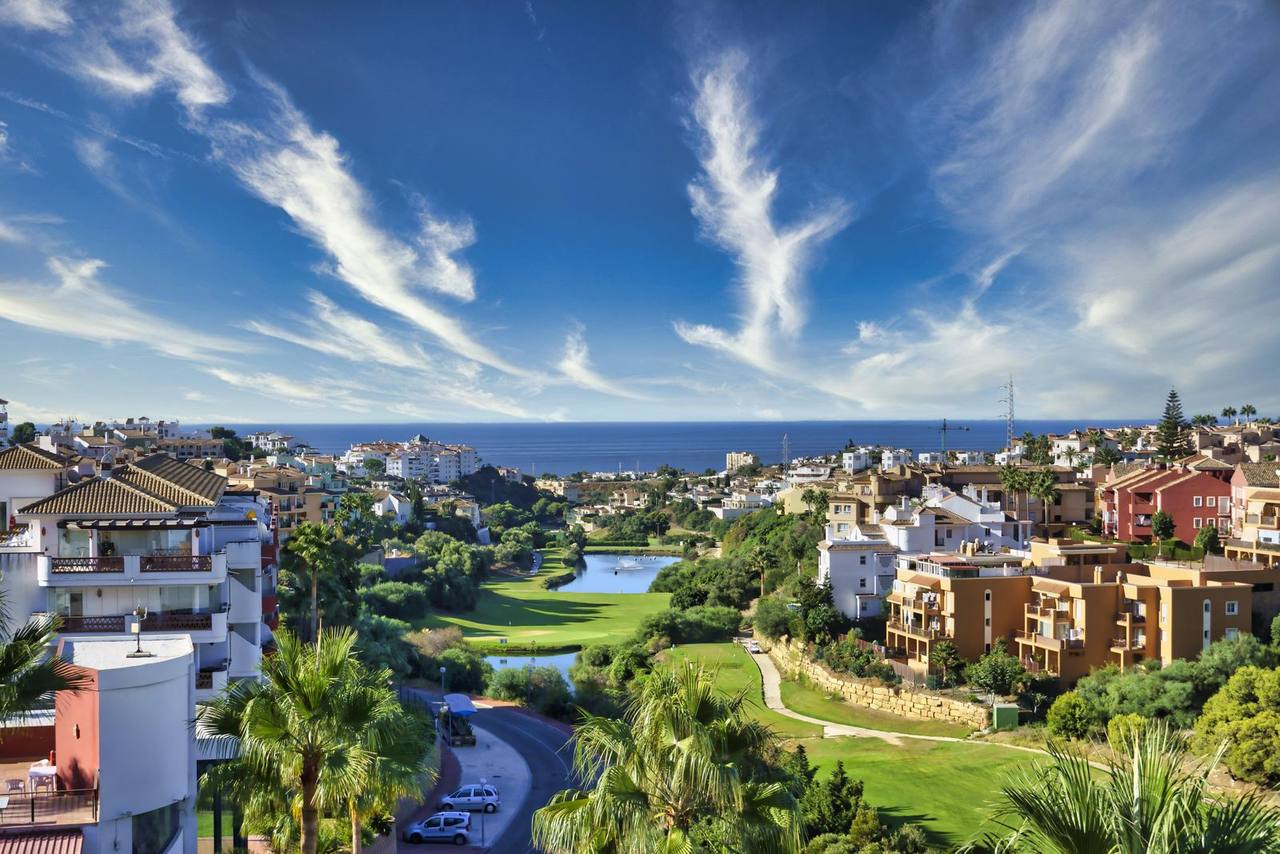
Mijas is usually described as three markets, and that is fair as far as it goes. There is Mijas Pueblo at 428 metres, the white village with its donkey taxis and its mountain views. There is the golf belt, where resort communities sit in their own landscaped quiet a short drive inland from the coast. And there is Mijas Costa, the long coastal sweep of pool-complex urbanisations running from Calahonda through Riviera del Sol. But inside that coastal third there is a fourth market that behaves nothing like the urbanisation belt around it, and it is small enough to walk across in fifteen minutes. That is the town centre of La Cala de Mijas itself.
We make the distinction deliberately, because the gap between La Cala town and the urbanisation belt to its east is wider than the gap between, say, Riviera del Sol and Calahonda. The urbanisations are residential by design. You drive in, you park, you let yourself into a gated complex, and almost everything you do afterward — the supermarket, the beach, dinner, the pharmacy — involves getting back in the car. La Cala's compact core is the opposite proposition. It is a town that was built to be lived in on foot, with a church square at its heart, a working high street of restaurants and bars, and a beach you reach by crossing one road. For a particular kind of guest, that single difference decides the whole stay.
What the walkable core actually is
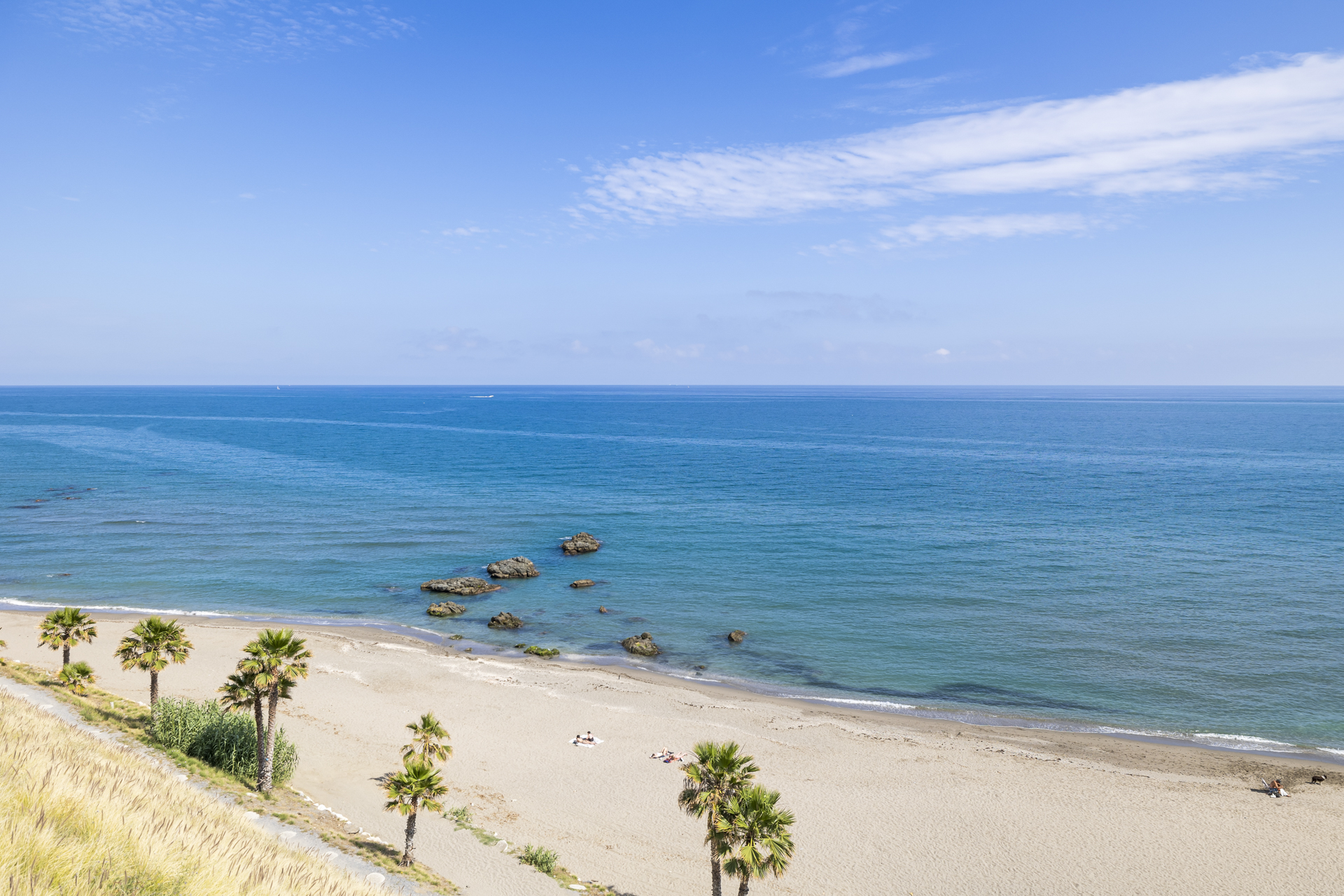
The town centre of La Cala de Mijas is genuinely small, and that is its strength. The plaza around the church anchors it. From there a short grid of streets runs down toward the seafront, and within those few blocks sits most of what a visitor needs for a week: a dense cluster of restaurants, tapas bars, cafés and beach chiringuitos, a couple of supermarkets, a pharmacy, the Saturday market when it runs, and the paseo that follows the shoreline. The beach is not a fifteen-minute drive or a shuttle ride away. It is at the bottom of the street.
That density is the product itself. A guest staying in an apartment two or three streets back from the plaza can step out of the door, walk to breakfast, walk to the beach for the day, walk back, change, and walk out again to dinner without ever moving a car. On the Costa del Sol, where so much of the holiday-rental stock is built around the assumption that everyone drives everywhere, that is genuinely uncommon. The urbanisation belt cannot offer it, however good the individual apartment is, because the urbanisations were not laid out as towns. La Cala's centre was, and it is the closest thing on this stretch of Mijas Costa to a guest being able to leave the hire car at the airport.
We think about this when we look at a property to take on. A two-bedroom apartment inside a gated complex on the A-7 side of the coast is a different rental product from a two-bedroom apartment three streets from the La Cala plaza, even if the floor plans match and the photographs look similar. The first sells the apartment. The second sells the apartment and the town it sits inside. Our property management approach treats those as two separate jobs, because the guest is buying two different things.
The guest who wants to step out of the door into a living town
There is a specific guest for whom the walkable core is not a nice-to-have but the entire reason they book. They are couples on a long weekend who do not want to organise a hire car. They are families with young children who would rather not strap everyone into car seats every time they want lunch. They are older visitors who have stopped enjoying driving on unfamiliar roads, and snowbirds settling in for several winter weeks who want a town that functions around them rather than a complex they have to drive out of. What these guests share is a preference for a stay where the logistics disappear and the town does the work.
For that guest, a quiet apartment in a beautiful gated urbanisation five kilometres from anything is a frustration, not a feature. They booked a holiday and got a commute. La Cala's centre solves this at the level of geography rather than service. The restaurants are there. The beach is there. The bakery is there. The evening, when the plaza fills and the chiringuitos along the seafront light up, happens on foot and within reach. We have seen the booking patterns that follow from this: guests who choose the walkable pocket tend to stay longer, return more readily, and ask fewer questions in the days before arrival, because there is less to arrange.
Marketing to that guest is mostly a matter of telling the truth precisely. The honest claim is not "central" — every listing on the coast claims central. The honest claim is the walk itself: the named distance to the beach in minutes on foot, the fact that the supermarket and the pharmacy are within the same few blocks, the specific reassurance that a car is genuinely optional for a week in the town. That specificity is what separates a real walkable let from the dozens of coastal apartments that borrow the word and cannot back it up.
How to market the walk-everywhere quality honestly
The temptation with a walkable property is to oversell it, and the brand we run does not allow that. So the rule we apply is simple: every claim about walkability has to be true for the guest who tests it on day one. If the listing says the beach is a few minutes on foot, it has to be a few minutes on foot from the actual front door, at a normal pace, with a buggy, not a measurement taken from the edge of the postcode. If the listing implies a car-free week is possible, then the supermarket, the restaurants and the pharmacy all have to be reachable without one. Overstate the walk and the guest finds out within an hour of arriving, and the review says so.
Where La Cala's centre earns its honest description is in the genuine density of what sits inside the walkable radius. The restaurant and bar count in the few streets around the plaza and along the seafront is high for a town this size, which means a guest is not walking to one option but choosing among many. That is the difference between a property that is technically near a couple of places and one that sits inside a living town centre. We write the listing around that real density — the plaza, the seafront paseo, the chiringuitos, the everyday shops — rather than around adjectives. An accurate map in the guest's head before arrival is worth more than any superlative.
Photography follows the same discipline. A walkable-core property is sold partly on the street outside it, so the images do not stop at the apartment. They include the short walk to the seafront, the plaza in the evening, the beach at the bottom of the road. The guest is buying the town as much as the rooms, and the income that a well-positioned central apartment can hold reflects that — but only if the listing earns the booking on something the guest can verify, not on a promise that collapses on arrival.
Why the walkable pocket holds shoulder-season demand
The seasonal behaviour of the La Cala core is the other reason we separate it from the urbanisation belt. A coastal apartment whose entire appeal is the pool and the proximity to the beach has a sharp season. It is wanted in July and August and much quieter in November, because in the off months the pool is cold and the beach is for walking rather than swimming, and there is little reason to be there. A walkable town centre does not depend on the pool or the swimming season in the same way, because the town keeps working when the beach weather stops.
In the shoulder months and into winter, the guest in La Cala's centre is not coming for a beach holiday. They are coming for a town that is open: restaurants serving, cafés on the plaza, the seafront paseo good for a long flat walk in mild weather, the everyday shops within reach. A snowbird settling in for several weeks of a Costa del Sol winter wants exactly this — somewhere they can live a normal daily life on foot, eat out without planning, and not feel marooned in a quiet complex. The walkable core offers that in October, in January, in March, in a way the pool-dependent urbanisation simply cannot.
That is why the central pocket tends to hold its occupancy across a longer span of the year than the belt around it. The peak summer weeks look similar on paper, but the months on either side behave differently. We factor this into how we price and position a central La Cala property: the shoulder season is not a write-off to be filled at any rate, it is a genuine demand window for the car-light, longer-staying guest, and the calendar is managed to capture it rather than to chase short summer-only bookings.
Where this sits within the wider Mijas picture
None of this displaces the other three Mijas markets — it sits alongside them. Mijas Pueblo up at 428 metres is a different proposition entirely: village character, mountain views, a smaller and more particular rental stock. The golf belt sells quiet, space and the course on the doorstep to a guest who positively wants to drive. The urbanisation belt from Calahonda through Riviera del Sol sells the pool-complex coastal apartment, with all the community-vote considerations that come with shared-pool buildings. The La Cala town centre sells something none of the others can: a stay where the guest leaves the car behind and the town does the rest.
For an owner, the practical consequence is that a central La Cala property should be run as a walkable let, not as a generic coastal apartment that happens to be in town. The listing leads with the walk. The pricing respects the longer shoulder season. The guest mix skews toward couples, families and longer-staying off-season visitors rather than peak-summer beach traffic alone. And the licensing and registration sit on the same Mijas framework as everywhere else on the coast — the same Junta de Andalucía declaración responsable for the VUT licence, the same NRUA national registration mandatory since July 2025, the same February N2 filing each year, and the same 3/5 community-vote considerations for any new application in a shared building. The town centre changes the marketing and the seasonal shape of the booking year. It does not change the paperwork.
If you own an apartment in or close to the La Cala de Mijas town centre and you want it run as the walkable let it actually is — priced for the shoulder season it can genuinely hold and marketed on a walk the guest can verify on day one — we will look at the property and the areas around it and give you an honest read on the rental year. Speak to our team via /for-owners/#contact and we will set up a call from the Arroyo de la Miel office.